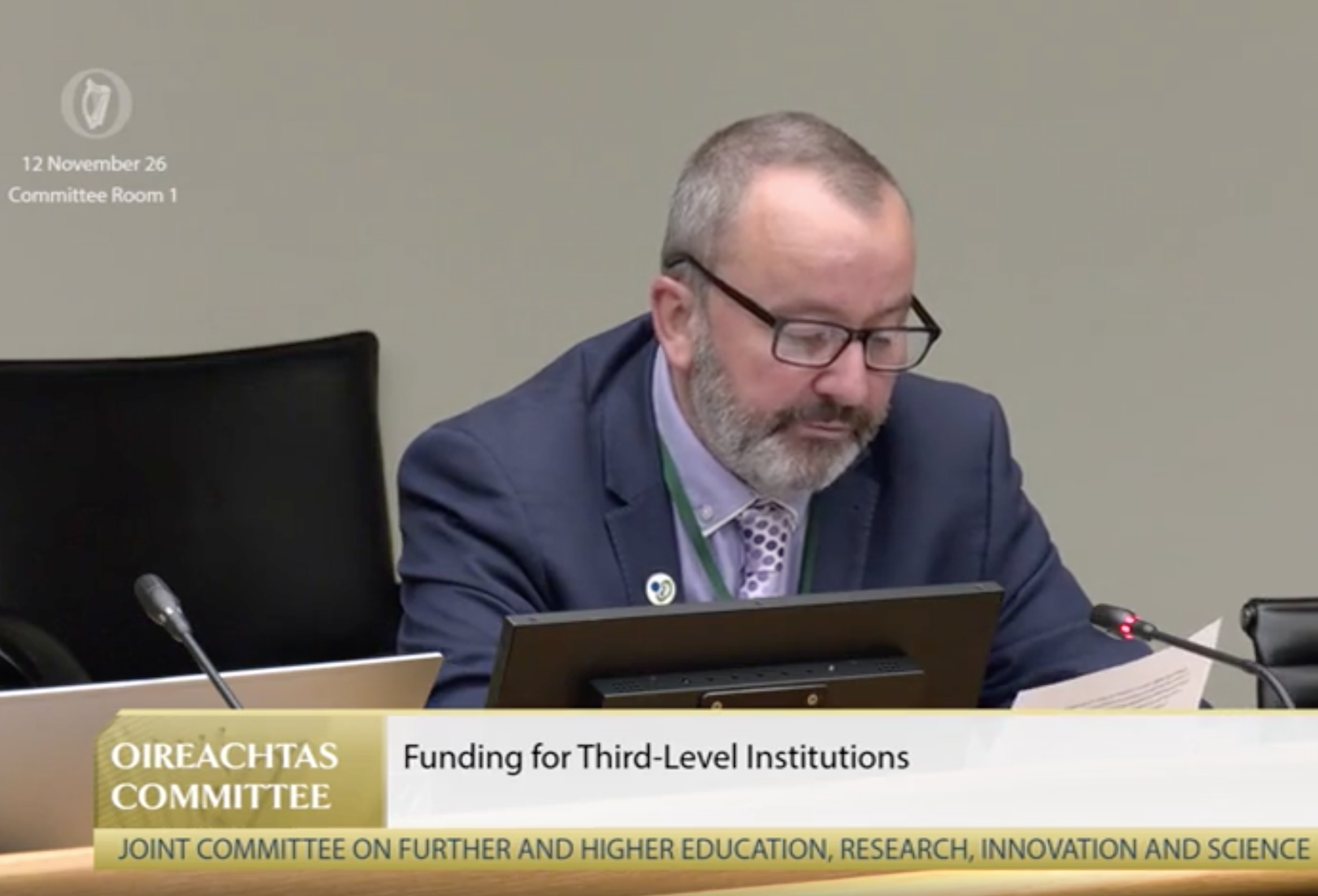
IFUT General Secretary Frank Jones called for an immediate increase in core funding for higher education and a binding multiannual plan to close the sector’s funding shortfall at an Oireachtas hearing yesterday afternoon.
He appeared before the Joint Committee on Further and Higher Education, Research, Innovation and Science alongside representatives of Aontas na Mac Léinn in Éirinn (AMLÉ), the Postgraduate Workers’ Organisation, SIPTU and the Teachers’ Union of Ireland (TUI). The hearing focused on funding for third-level institutions.
In his opening statement, Frank drew attention to The Future Funding of Higher Education, published in July 2022 by the predecessor committee after extensive submissions from trade unions and employers. The report recommended multiannual public funding that reflects student enrolments, a workforce plan to restore staffing levels and the abolition of the Employment Control Framework. IFUT acknowledged that some progress has been made on funding since 2022, however costs have increased, and told the Committee that key recommendations on funding and staffing still need to be acted on. Read the 2022 Oireachtas Committee report.
The General Secretary also brought the ICTU Group of Further and Higher Education Trade Unions’ 2026 edition of The Case for Publicly Funded Higher Education to the Committee’s attention. Several Committee members had attended its launch in Leinster House on 21 October. He compared the new edition with the original 2020 paper, which he had brought to the predecessor committee’s attention as part of IFUT’s February 2022 submission. That paper formed part of the evidence that helped inform the committee’s ten key recommendations. The 2026 edition shows how pressures on funding, staffing and access have intensified since the original paper. Read the 2020 edition and the 2026 edition.
The Government’s Funding the Future policy identified a €307 million annual core funding gap in 2022. While that original gap has narrowed, the Irish Universities Association told the Committee in October that the current annual shortfall exceeds €250 million once pressures including unfunded pay costs and rising student numbers are taken into account. For staff and students, those pressures mean heavier workloads, insecure employment and less time for feedback, supervision and individual support.
IFUT also asked the Committee to recommend that doctoral candidates be recognised and treated as workers and that their stipends be replaced with salaries. This would give doctoral researchers access to employment protections and create more opportunities for them to gain paid, face-to-face teaching experience, with teaching duties compatible with their research. For institutions, the change could help ease immediate staffing pressures and improve student–staff ratios, while giving students more access to in-person teaching and tutorials.
IFUT called for the Government to fund nationally agreed pay increases in full through additional central allocations, protecting budgets for teaching, research and student services. It also called for funded recruitment and more secure academic and research careers, alongside a permanent sectoral forum bringing Government, agencies, employers, unions and students together to address funding, workforce planning and employment conditions.