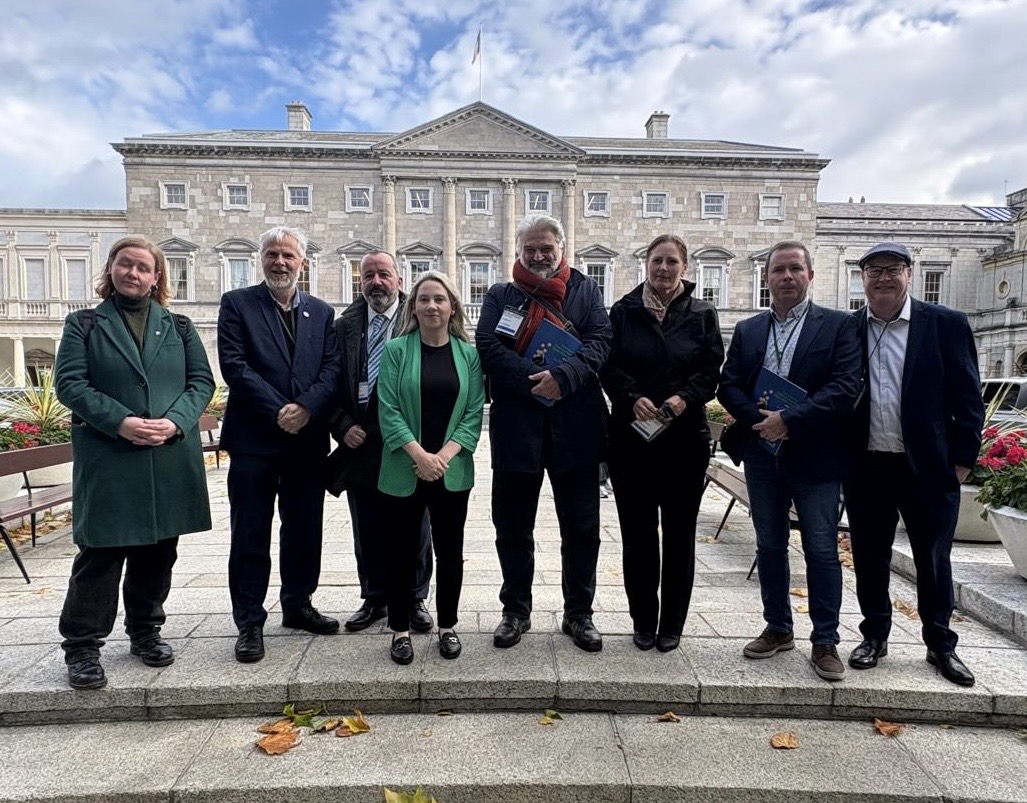
The ICTU Group of Further and Higher Education Unions today launched the 2026 edition of The Case for Publicly Funded Higher Education in the AV Room, Leinster House, setting out the evidence for sustained State investment in the sector and a funded, multiannual plan to deliver it.
The launch was hosted at the invitation of Senator Laura Harmon (Labour), who invited the Group to present the document at Leinster House. IFUT General Secretary Frank Jones, who chairs the Group, launched the report. Representatives from each of the unions in the Group spoke on different aspects of its findings. The Group of Unions comprises of representatives from SIPTU, UNITE, Forsa, the TUI, Connect and IFUT.
They were joined by IFUT President Michael Hinds, and by Paul Gavan and Tom Sheppard of the Irish Congress of Trade Unions (ICTU). Those attending included Patrick Paul Walsh, IFUT’s nominee for the current Seanad vacancy, and representatives of AMLÉ and the Postgraduate Workers’ Organisation.
“Higher education serves the whole of society”
Introducing the report, Frank Jones said the central argument was straightforward: higher education serves the whole of society, and the State has a responsibility to fund it fully and sustainably.
Its benefits, he said, reach far beyond the individual graduate. Higher education develops public services, supports employment and regional development, advances science and enriches cultural life. It strengthens democratic participation and equips people to examine evidence, challenge injustice and respond to the great questions of our time. Those benefits are shared by people who may never enter a university themselves, which, he argued, makes a compelling case for collective investment through public funding.
What the report finds
The 2026 edition updates the Group’s 2020 report and concludes that the pressures it identified then have intensified. Among its key findings:
- A funding crisis that has become structural. Core government funding for higher education fell by approximately 30% in real terms between 2008 and 2015, while student numbers kept growing. A decade after the Cassells Report, no long-term funding model has been implemented.
- Rising demand. Student enrolments have grown by 57.1% since 2007/08, reaching 278,880 in 2024/25, the largest single-year percentage increase since 2020/21.
- Unequal access. Only 5.3 students from disadvantaged areas attend higher education for every 10 from affluent areas, little changed from 4.9 in 2020. A student living away from home in Dublin faces annual costs of €23,600 to €30,800, while the maximum SUSI maintenance grant is €5,915.
- Overstretched staff. Ireland’s student-staff ratio of approximately 19:1 compares with an OECD standard of 15:1. Reaching that standard would require approximately 6,500 new academic posts.
- Insecure careers. IFUT’s 2023 research found that 36% of staff consider themselves precariously employed, and that only 15% of researchers are on permanent contracts.
- Growing dependence on private income. Institutions are increasingly reliant on non-EU student fees and commercially financed student accommodation in the absence of adequate public funding.
The report also stresses that access must mean more than receiving an offer of a place: students must be able to afford to take that place, participate fully and complete their studies. Education can overcome inequality, it argues, but an education system shaped by the ability to pay can reinforce it.
Evidence from the Oireachtas
Frank Jones said evidence given to the Oireachtas last week underlined the urgency of the case. Paul Johnston, Director General of the Irish Universities Association, told the Joint Committee that the real annual core funding gap now exceeds €250 million, while Mike Beary, Chair of UCD’s Governing Authority, described an institution operating at the limit of its capacity.
He drew three conclusions:
- Headline figures do not show whether the system is adequately funded. New recurring core funding must be distinguished from capital allocations, targeted programmes and funding that meets existing commitments. Budget 2027 provided only €10 million in new core funding. The test, he said, is whether institutions have the recurring resources to deliver their public mission.
- The funding gap moves. Government identified a €307 million shortfall in 2022. Reducing part of that figure does not settle the question when student numbers, pay costs and other essential costs have continued to rise. Funding must meet the actual cost of provision today.
- The consequences are borne by people. Bringing the student-staff ratio closer to the OECD average of 15:1 would mean more time for teaching, feedback, supervision and research.
“Staff commitment cannot become a permanent substitute for adequate funding,” he said. “Public investment must deliver secure jobs, manageable workloads and better education.”
The way forward
The report sets out a framework for reform, including:
- sustained public investment and a long-term, sustainable funding model for higher education;
- a 10-year staffing plan delivering approximately 6,500 new posts, and the removal of the Employment Control Framework;
- clear pathways to permanency, an end to precarious employment and meaningful sector-wide collective bargaining;
- action to reduce student costs, including rents, and to expand SUSI supports;
- achieving the OECD standard 15:1 student-staff ratio; and
- protected research careers in place of precarious, project-based employment.
The Group also renewed its call for structured sectoral engagement bringing together Government, employers, unions and student representatives. Frank Jones said there appeared to be general agreement on the point, and that it was “high time” the Minister asked his Department to put it in place.
He asked members of the Oireachtas to support “a funded, multiannual plan that closes the real shortfall, widens access and provides the staffing and secure careers the sector needs”.
A tribute to Macdara Doyle
Frank Jones paid tribute to the late Macdara Doyle, whose work in late 2019 and early 2020 produced the first version of the document. The 2026 edition, he said, carries forward an argument to which Macdara made an enduring contribution.
He thanked Senator Laura Harmon for organising the launch, and Tom Sheppard and Paul Gavan of ICTU for their support in preparing the report. The Foreword also acknowledges contributions from Rory McGann of Mary Immaculate College and Brendan Palmer of University College Cork.
Download The Case for Publicly Funded Higher Education (2026 Edition)