IFUT public service campaign
Members stood together
Monday's one-hour stoppage showed the strength, solidarity and organisation of IFUT members across higher education.
Monday, 5 October 2026
Successful first day of industrial action
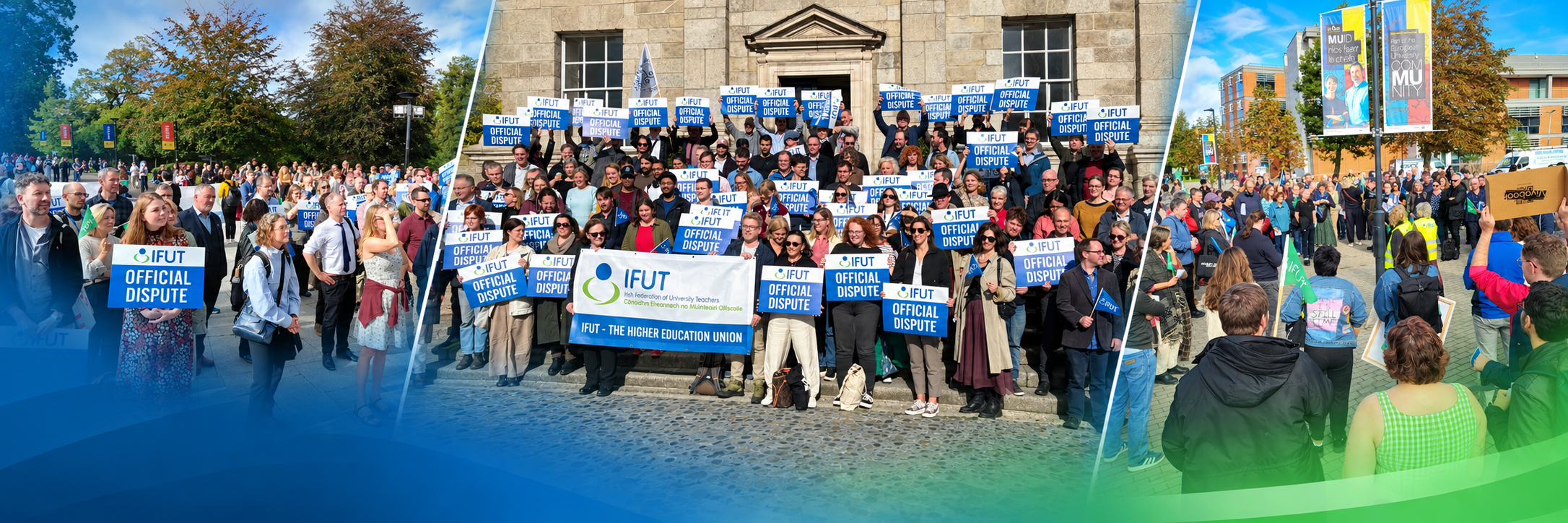
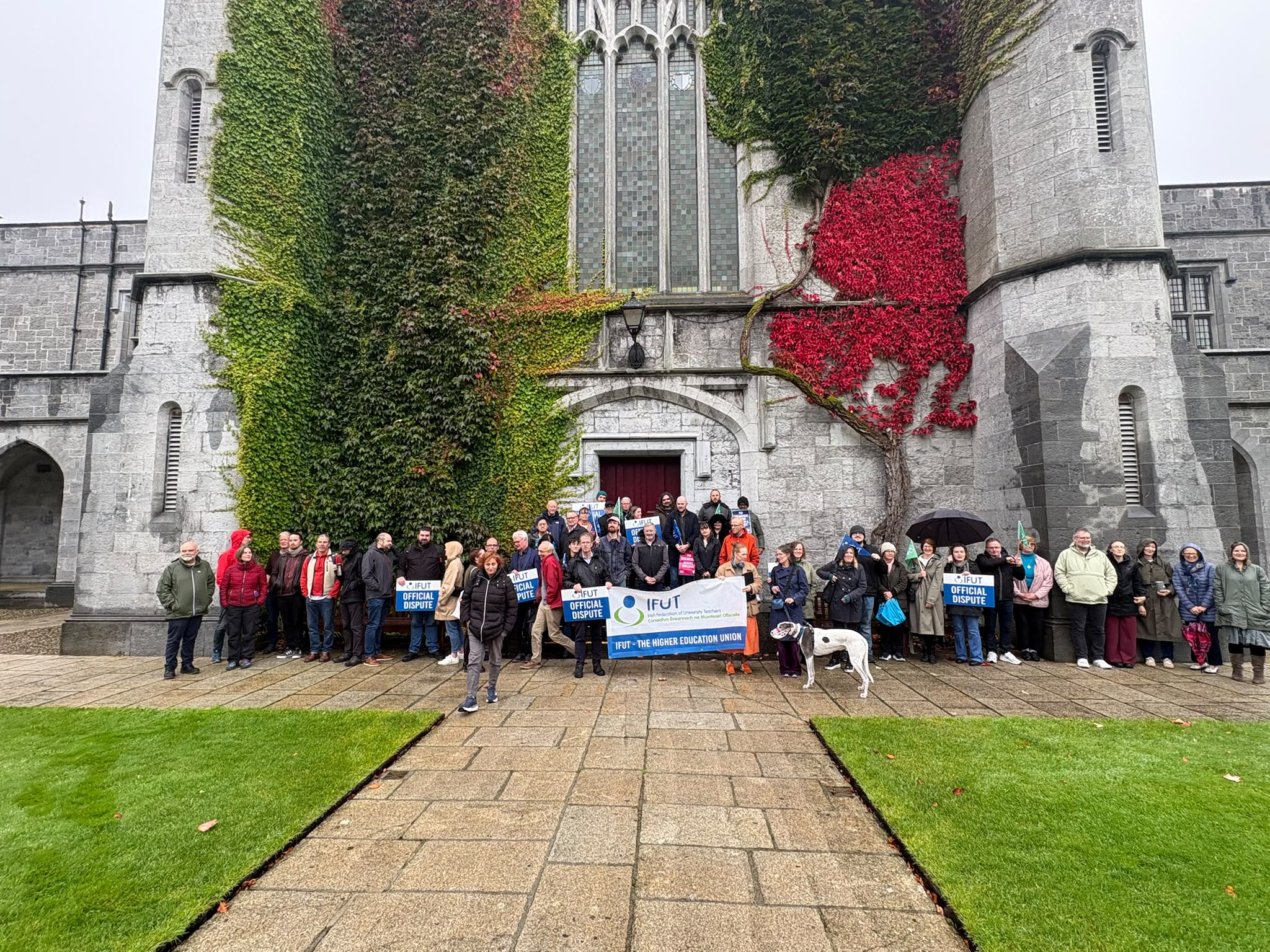
IFUT members across participating universities and higher education institutions successfully withdrew their labour from 12 noon to 1.00 pm, marking the first action in the current public service dispute.
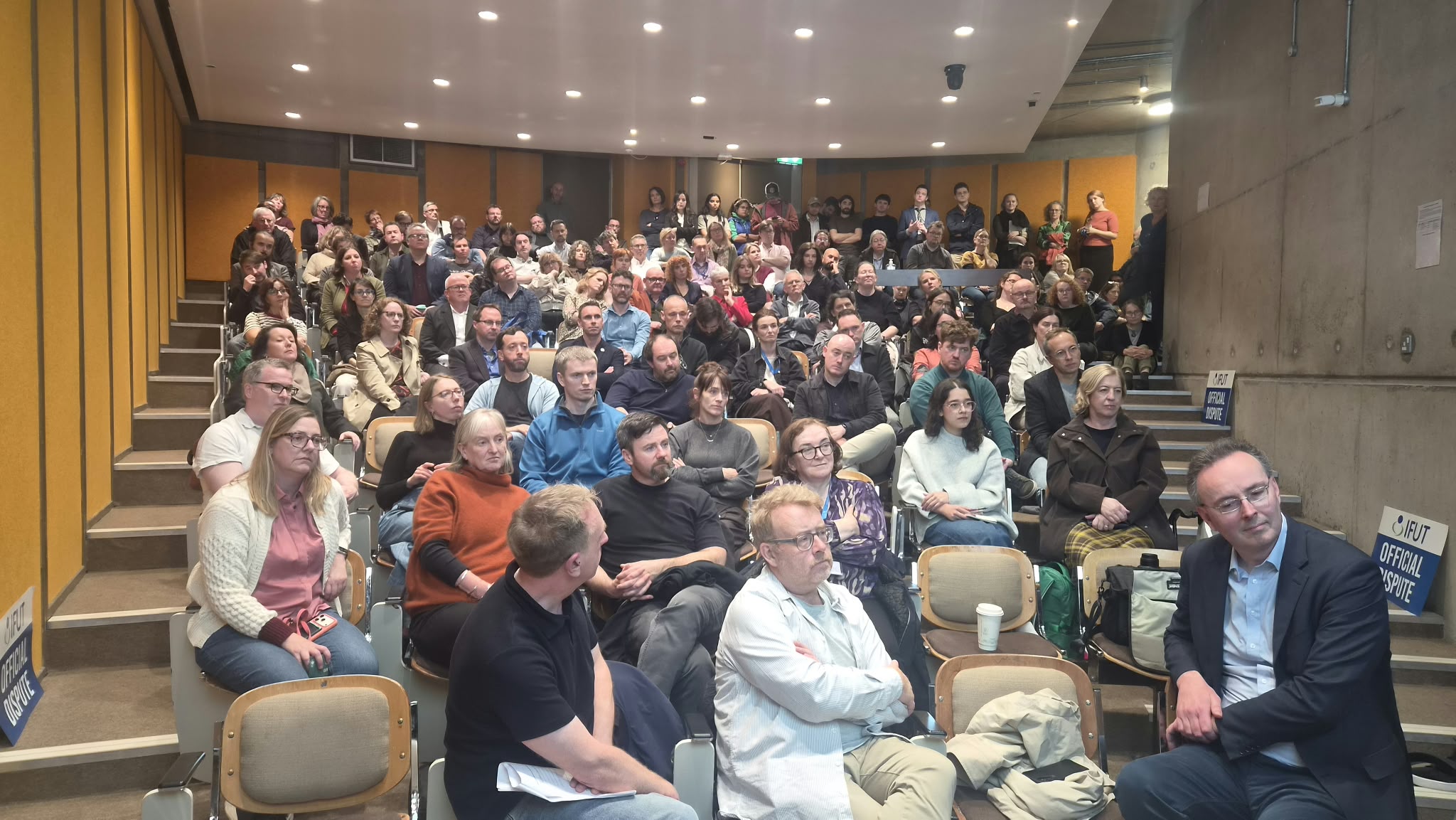
Members gathered on campuses for visible demonstrations of solidarity, discussions and teach-ins. The action showed their determination to secure fair pay, delivery of outstanding commitments and respect for collective bargaining.
IFUT thanks every member who participated, together with the branch officers, representatives and activists who organised the action locally, and the students and colleagues who showed their support.
The next step
Register for 14 and 21 October
Picket registration is now open for both strike days. Select your preferred slot for 14 and 21 October. Strong, well-organised pickets depend on members signing up early and making sure every shift is properly supported.


A decisive mandate for action
The IFUT public service ballot closed at 12 noon on 22 September 2026. Members voted overwhelmingly in favour of industrial action.
This result gives IFUT a clear mandate to act with public service unions across the country in pursuit of a fair pay agreement and the union's outstanding claims.
The next phase
IFUT has announced an initial programme of coordinated industrial action. Members should follow all national and branch instructions.
Successful first action
Members withdrew their labour for one hour across participating institutions and stood together in solidarity.
24-hour strike
Members should not undertake work. Workplace pickets and other branch activity will take place.
Further 24-hour strike if necessary
This action will proceed if the dispute remains unresolved. IFUT will keep members advised.
What the dispute is about
The Public Service Agreement 2024 to 2026 expired on 30 June. There is no successor agreement, no agreed pay provision covering the remainder of 2026 and no satisfactory negotiating process under way.
The demand is straightforward: the Government must come to the table and negotiate meaningfully with the unions representing public service workers.
IFUT is seeking:
- An acceptable pay settlement covering July to December 2026.
- Appropriate pay increases for 2027 and under any successor agreement.
- Early conclusion and full implementation of outstanding claims under the 3 per cent Local Bargaining Clause.
- Protection against unilateral changes to work practices, the organisation of work or organisational structures without agreement with the union.
Key information for members
Ballot result and campaign update
Read the full announcement on the decisive Yes vote and the next phase of the campaign.
IFUT Picketing Guidelines 2026
Official guidance for members, branch officers and picket captains on lawful, peaceful and safe picketing.
Questions and answers
Select a question to open the answer. Any later instruction issued by IFUT or your local branch takes precedence over this general guidance.
The ballot result and next steps
What was the result of the IFUT ballot?
Members voted decisively in favour of industrial action, up to and including strike action. The Yes vote was 93 per cent.
Why are IFUT members taking industrial action?
IFUT members are taking industrial action because the Government has failed to commence meaningful negotiations with public service trade unions on a new public service pay agreement. Public service workers need a credible approach to pay from 2026 onwards that protects living standards.
What does the Yes vote authorise?
The result authorises IFUT to take industrial action, up to and including strike action, in pursuit of the union's claims. IFUT has now announced the initial action on 5, 14 and 21 October. Members should act only on formal instructions from IFUT and their branch.
What happens after 21 October?
That will depend on the Government's response. IFUT will assess developments with the wider public service union campaign and advise members of any further action.
How will members receive further instructions?
IFUT will issue national updates, while branches will confirm local arrangements such as picket locations, rosters, start times and other organised activity. Members should ensure IFUT holds their current contact details and should monitor union communications.
Work stoppages and participation
When will the work stoppages take place?
- Monday, 5 October: a one-hour work stoppage from 12 noon to 1.00 pm.
- Wednesday, 14 October: a 24-hour strike.
- Wednesday, 21 October: a further 24-hour strike if necessary.
Do I report for work on the strike dates?
You should assume that you will not be working and will not be paid for the work stoppage hour or for the entirety of the two strike days. You should not report for work or carry out any work on 14 or 21 October. On 5 October, you should stop work for the announced hour and follow your branch's instructions.
The withdrawal of labour must be total to maximise its effectiveness. Follow local instructions about attending a picket or another organised activity.
What if the institution tells me to work during the industrial action?
You should not work during the notified industrial action. All IFUT members covered by the action are expected to participate. If the institution asks or instructs you to work, explain that you are participating in official IFUT industrial action and refer any further issue to your Branch or IFUT.
What if the institution says the work is essential or urgent?
Do not make that decision individually. Refer the request to your Branch or IFUT. Any derogation or exemption must be considered through the agreed union process.
What work is covered by the stoppage?
The stoppage covers normal university duties, including teaching, research, student supervision, assessment, marking, administration, management duties, meetings, interviews, training and university events. It also covers work-related calls, emails and online messages.
Can work be rescheduled, recorded or caught up later?
Members should not make individual arrangements designed to remove or minimise the effect of the industrial action. Teaching timetabled during the action must not be rescheduled, delivered at another time or replaced with a recording. The same principle applies to meetings, supervision and other affected duties.
Normal work will resume after the action, but members should not undertake to recreate work specifically withdrawn as part of the action without union guidance. Refer any request to reschedule or replace work to your Branch or IFUT.
Does the stoppage apply to remote working?
Yes. The action applies equally to members working remotely. You must withdraw your labour fully and must not answer emails, prepare lectures, mark, conduct research or carry out other normal duties from home.
Wherever reasonably possible, members working remotely should participate in person at their institution. On the 24-hour strike days, members should attend the local picket arrangements rather than treating remote working as an alternative to participation. If an exceptional reason prevents you from attending, you must still withdraw your labour fully and should contact your Branch for guidance.
Should I attend meetings or university events?
No. During a stoppage, members should not attend meetings, committees, interviews, training sessions, conferences or other work-related events, whether they take place in person or online.
What time does a 24-hour strike begin and end?
Your branch will confirm the precise local start and finish times and the arrangements for pickets and rosters.
How will my employer know that action is taking place?
IFUT will serve the required formal notice of industrial action on employers. Members do not need to give separate notice unless IFUT advises otherwise.
What should I do if I am put under pressure because I am taking part?
Contact your Branch or IFUT immediately. Members are participating in official industrial action authorised by the union, and IFUT will robustly defend members' right to participate.
What is a derogation or exemption?
A derogation is an agreed exception to industrial action, normally where genuinely exceptional circumstances justify particular work continuing. Members must not agree derogations individually with the institution. Any request should be referred to the Branch or Strike Committee and considered through the agreed union process.
Can I simply decide not to take part?
No. Members covered by the action are expected to participate unless an agreed derogation or exemption has been granted.
Deliberately refusing to participate without an agreed derogation may give rise to action under the Rules of IFUT, including where the conduct is considered prejudicial to the interests of the Federation. Any matter would be dealt with under the Rules and the appropriate procedures. A member with a genuine difficulty should contact their Branch or IFUT.
What if I leave IFUT because I do not want to take part?
Resigning from IFUT does not provide a simple route for avoiding an ongoing trade union dispute. Congress transfer arrangements also restrict another affiliated union from accepting a member who is engaged in a trade union dispute without the consent of the existing union.
If you have a genuine difficulty about participating, raise it with your Branch or IFUT rather than simply opting out.
Pay, leave and individual circumstances
Will I lose pay?
Members should assume that employers may deduct pay for periods during which labour is withdrawn. For 5 October, that is the one-hour stoppage. For 14 and 21 October, members should assume that a full day's pay may be deducted. The precise payroll treatment may vary between institutions.
What if I am part-time, hourly paid or use a clocking system?
You are still expected to participate in the industrial action. IFUT recognises that deductions may have a greater financial impact on part-time, hourly paid and lower-paid members, but the action has been authorised collectively and applies to members covered by the dispute. Contact IFUT if you need advice about your circumstances.
Will IFUT provide strike pay or financial assistance?
IFUT will not make strike payments for days on which members are engaged in industrial action. However, Branches have local funds and can consider individual requests for assistance in cases of financial hardship. Members wishing to make a request should contact their Branch directly and confidentially.
What if I am on probation, a fixed-term contract or in a precarious role?
There is no general exemption from official industrial action because a member is on probation, on a fixed-term contract or otherwise precariously employed. Members in these circumstances are covered by the union's instructions. If you have a specific concern about your employment situation, contact IFUT directly.
What if I already have approved annual leave?
Annual leave approved before the industrial action was announced should be taken as normal.
Can I book annual leave for a strike date?
Members should not use annual leave as an alternative to taking part in authorised industrial action. If you need annual leave for a genuine reason, contact your IFUT representative before submitting the request.
What if I am on sick leave or another authorised absence?
Contact IFUT for guidance if you are on sick leave, maternity leave, parent’s leave, parental leave or another existing authorised absence.
Pickets and conduct
Do I have to picket on 14 and 21 October?
Members are expected to participate fully in the strike and support the local arrangements organised by their Branch. Where a picket is being organised, members should make every reasonable effort to attend their assigned slot. The Branch will provide the location, starting time and roster arrangements. Attending a picket is not the same as reporting for work.
What if my institution closes on a strike day?
A closure does not remove the need for visible collective action. Branches will organise pickets at agreed entrances or other appropriate locations and will ask members to join a picket for an allocated period. Members should follow their branch's roster and local instructions.
Who may take part and where may picketing take place?
Official pickets may include employees of the employer in dispute, IFUT staff and officers representing them, and authorised IFUT representatives. Picket locations must be agreed in advance by the branch or strike committee and IFUT Head Office.
How should I behave on a picket line?
Follow the directions of the designated picket captain. Remain peaceful, professional and courteous. Explain the dispute calmly and ask others to respect the picket. Do not obstruct access, intimidate or threaten anyone, engage in confrontation or consume alcohol or drugs on the picket line.
What if I cannot attend the picket?
Contact your branch representative as early as possible. Members who cannot attend because of illness, disability, caring responsibilities or another genuine reason should inform the branch and seek advice.
What if another union gives different instructions?
Members should follow the instructions issued by their own union. IFUT will liaise with other unions where appropriate. Refer any uncertainty to your IFUT representative.
Can I speak to the media or post about the picket?
Refer media enquiries to the authorised IFUT spokesperson or Head Office unless a local spokesperson has been designated. Exercise care on social media and do not publish confidential information, defamatory statements or inaccurate content.
What health and safety arrangements apply?
Branches and picket captains should take account of weather, traffic, visibility, accessibility and personal safety. Members should wear suitable clothing and any high-visibility equipment provided, take agreed breaks and report accidents, near misses or safety concerns immediately.
Download and read the full IFUT Picketing Guidelines 2026 above.
The wider public service dispute
What is happening with talks with the Government?
There are currently no talks taking place. Preliminary engagement in June did not convince union negotiators that living standards would be protected by the Government's proposed approach to a new agreement.
Public service unions have consistently said that Government must begin with a credible approach to pay from 2026 onwards that properly addresses cost-of-living pressures.
Why are unions not entering talks when Ministers say they are open to talks?
Talks must have a clear purpose from the outset, including a credible approach to protecting living standards through pay. Unions are seeking certainty that pay for 2026 onwards will be addressed, rather than entering prolonged talks without a credible route to resolving the dispute.
Will unions enter another multi-annual agreement?
Only if it adequately addresses the cost of living first and satisfactorily deals with other priority matters, including privatisation and outsourcing, remote working and the impact of artificial intelligence.
Have public service wages kept up with inflation?
Union analysis shows that public service pay has fallen significantly behind prices in recent years. Annual inflation was reported at 3.7 per cent in September 2026, while pay improvements delivered in 2026 amount to an average increase of approximately 1.5 per cent across the year.
What about increases for lower-paid workers?
The previous agreement included fixed monetary alternatives for some increases so that lower-paid workers received whichever amount was greater. For example, the February 2026 increase was 1 per cent or €500, whichever was more beneficial. This was a deliberate trade union achievement.
Are public service unions coordinating their action?
Yes. Nineteen unions with members working in the public service participate in the ICTU Public Services Committee. Sectoral differences mean that some action may vary, but unions are coordinating timing and tactics where possible to maximise their collective impact.
What forms can industrial action take?
Industrial action can include work to rule, refusing to cover vacant posts, overtime bans, non-cooperation with particular systems, picketing and work stoppages of different durations. Disputes often have several phases, and members are informed when action is escalated.
What legal protection applies to members taking action?
Official industrial action taken following a lawful ballot attracts statutory protections. Those protections depend on the action remaining within the law and within union instructions. Members should take part only in action authorised by IFUT and should contact the union if they have an individual concern.
Need further information?
Members with an individual query should contact admin@ifut.ie or their local IFUT branch. Any dispute-specific instruction issued later by IFUT or a branch takes precedence over this general guidance.