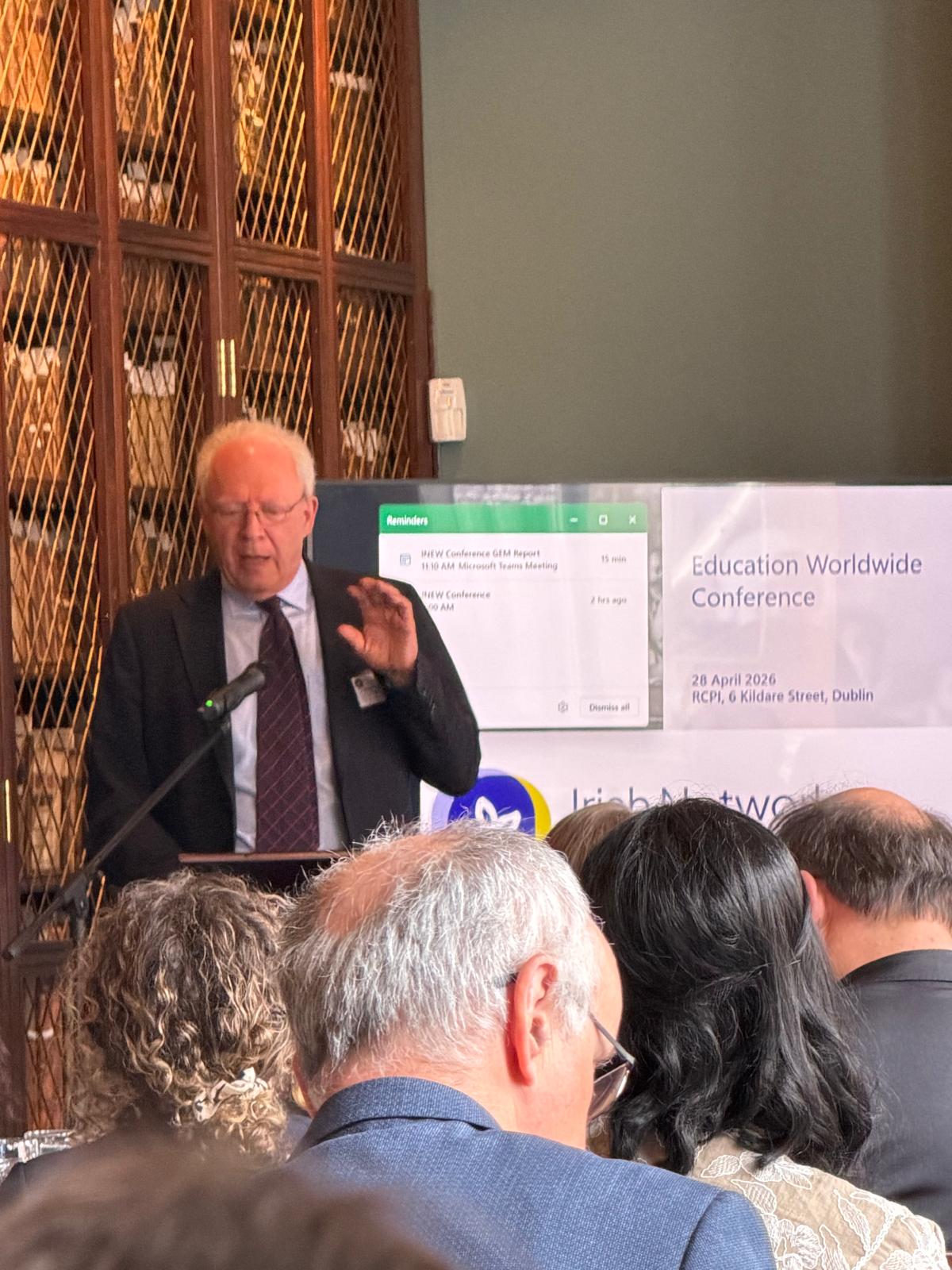
It was both a privilege and a genuine pleasure to represent the Irish Federation of University Teachers (IFUT) at the inaugural Education Worldwide Conference, organised by the Irish Network for Education Worldwide (INEW), which took place in the Royal College of Physicians, Dublin, on Monday 28 April.
As General Secretary of IFUT, and as a member of the INEW Steering Committee, I was honoured to participate in what was an exceptionally important and well-executed event, bringing together education advocates, trade unionists, policymakers, and global justice campaigners committed to advancing educational opportunity across the world.
I want to extend particular thanks and recognition to Ponke Danker, INEW Coordinator, whose outstanding work in organising this conference was evident throughout. Ponke delivered an event of the highest quality, assembling an exceptional and diverse range of speakers whose expertise, passion, and lived experience brought both urgency and clarity to the discussions. Her leadership and commitment ensured that this first conference was not only a success, but a deeply meaningful contribution to the global education movement.
Among the many outstanding contributions, Rafat Sabbah, President of the Global Campaign for Education (GCE), delivered an especially powerful intervention, highlighting in stark and compelling terms the scale of the challenges facing the international community in delivering on the United Nations Sustainable Development Goals (SDGs), particularly SDG 4: to “ensure inclusive and equitable quality education and promote lifelong learning opportunities for all” by 2030.
The conference served as a sobering reminder that, despite global ambition, it is now widely accepted that the SDG timelines will not be met. The reasons are complex and deeply interconnected: the lasting consequences of COVID-19, escalating global conflict, unsustainable debt burdens across lower-income nations, and the rise of increasingly inward-looking political agendas in countries that have traditionally contributed significantly to international development efforts.
As I noted during the conference:
“Inclusive and equitable quality education cannot be delivered in countries where spending per student remains as low as $20 per year, as is the reality in some African nations. By comparison, in Ireland, our expenditure averages approximately €8,500 per student annually across primary and post-primary education.
The real challenge is that there is not yet universal acceptance that improving the quality of education worldwide, and meaningfully supporting teaching and learning, is to the direct benefit of all nations and peoples, whether in the first or third world.
This is the message that must be understood by all.”
Education remains one of humanity’s most powerful tools for reducing inequality, fostering social justice, promoting sustainable development, and strengthening democratic societies. Yet without sustained political will, international solidarity, and genuine investment, millions will continue to be denied access to this fundamental right.
This conference reaffirmed the importance of global cooperation and advocacy in the pursuit of educational justice, and IFUT remains fully committed to supporting these efforts alongside our partners in INEW, the Global Campaign for Education, and the wider international movement.
My sincere thanks again to Ponke Danker for her exceptional leadership, professionalism, and vision in making this landmark event possible.