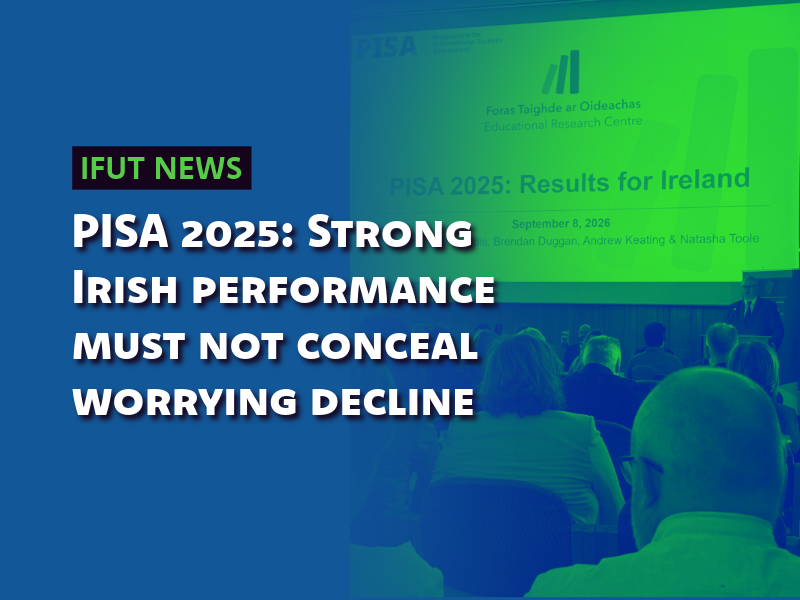
IFUT General Secretary Frank Jones attended the launch of the Programme for International Assessment (PISA) 2025 results this morning (September 8). The report was formally launched by the Minister for Education and Youth, Hildegarde Naughton TD.
At the launch, the Educational Research Centre (ERC), which implements PISA in Ireland on behalf of the Department of Education and Youth, presented its PISA 2025 Performance Report for Ireland: Summary Brochure. The brochure provided a clear and accessible account of how Ireland’s 15-year-old students performed across the different areas assessed.
The Irish Federation of University Teachers (IFUT) has welcomed Ireland’s strong performance in the OECD’s PISA 2025, while warning that the continuing decline in reading and mathematics requires a properly resourced, education-led response.
PISA is the world’s largest international study of educational achievement. It assesses how effectively 15-year-old students can apply their knowledge and skills to real-world challenges. More than 760,000 students from 91 countries and economies participated in 2025, including 6,356 students from 172 schools in Ireland.
The 2025 assessment focused principally on science, while also examining reading, mathematics and computational problem-solving. It explored students’ attitudes towards learning, including curiosity, perseverance and their use of artificial intelligence.
Ireland remains a strong performer
Ireland’s students continue to perform very well internationally. They achieved average scores above both the OECD and EU averages in all four areas assessed:
· Science: Ireland scored 500, compared with an OECD average of 482 and an EU average of 476.
· Reading: Ireland scored 500, compared with an OECD average of 461 and an EU average of 451.
· Mathematics: Ireland scored 480, compared with an OECD average of 463 and an EU average of 460.
· Computational problem-solving: Ireland scored 511, compared with an OECD average of 500 and an EU average of 492.
Ireland ranked first among the 27 EU countries for reading, third for science and fourth for mathematics. Irish students were also more likely than the OECD average to achieve at least the basic level of proficiency in science, reading and mathematics.
These results reflect positively on Ireland’s public education system and, above all, on the commitment and professionalism of teachers, school leaders, education support staff, students and their families.
Welcoming the report, IFUT General Secretary Frank Jones said:
“The PISA 2025 findings demonstrate that 15-year-olds in Ireland continue to perform extremely well when compared with their counterparts across the European Union and the OECD. That is
something we should acknowledge and celebrate, and it is a tribute to the work undertaken every day throughout our education system.
“However, strong international rankings cannot be allowed to conceal a worrying underlying trend. Ireland’s results are deteriorating from one PISA report to the next. While the decline may not be as severe as that experienced in many other countries, it is real and it must be addressed.”
Reading and mathematics results have declined
Ireland’s average reading score fell from 516 in 2022 to 500 in 2025, while its mathematics score declined from 492 to 480. Science performance remained broadly stable.
The longer-term picture is also concerning. Ireland’s 2025 reading and mathematics results were significantly below those recorded in both 2015 and 2018.
Between 2022 and 2025, the performance gap between Ireland’s highest- and lowest-achieving students widened in both reading and mathematics. Students attending DEIS schools achieved average results between 30 and 53 points below those attending non-DEIS schools, depending on the subject assessed.
“These findings underline the importance of looking beyond national averages,” Frank Jones said. “An education system must be judged not only by how its highest-performing students succeed, but by how effectively it supports every child, irrespective of income, background or location.”
A wider international warning
Education International’s briefing on the report highlights that PISA 2025 recorded the lowest OECD-average performance observed to date in science, reading and mathematics.
Of particular concern is the decline in the reading skills that are becoming increasingly important in the age of artificial intelligence: evaluating information, making connections between different sources and thinking critically about what we read. PISA also found that students experienced increasing difficulty when engaging with longer texts.
The findings on AI are complex. Students who did not use AI chatbots for particular schoolwork tasks generally outperformed those who did. However, students who used AI alongside opportunities to develop proper AI literacy performed somewhat better. Those opportunities were more commonly available to students from advantaged backgrounds, creating a risk of a new digital and educational divide.
In Ireland, 26% of students reported using AI chatbots to support their learning at least once a week, compared with an OECD average of 46%. This reinforces the need for a thoughtful, evidence-based approach to AI in education, developed with educators rather than imposed upon them.
Teachers must be provided with the time, training, professional autonomy and resources necessary to integrate new technologies appropriately. Technology and AI should support education and human interaction, not replace teachers or diminish the importance of reading, reflection and independent thought.
Staffing, infrastructure and student well-being
The report also identifies significant pressures within Irish schools. Some 62% of Irish students attended schools whose principals reported that teaching was hindered, at least to some extent, by a shortage of teaching staff. The OECD average was 39%.
There has also been a marked deterioration in reported material conditions. In 2025, 46% of students in Ireland were in schools where shortcomings in physical infrastructure were considered to hinder instruction, compared with 26% in 2022.
Bullying increased between 2022 and 2025, while around 40% of Irish students reported having missed at least one full day of school during the two weeks preceding the assessment—well above the OECD average of 22%. Students also reported a decline in regular family support.
These findings demonstrate that educational outcomes cannot be separated from staffing levels, school conditions, student well-being, social inequality and the availability of properly funded support services.
Investment, not blame
The PISA findings must not be misused to blame students, teachers or individual schools. Education International rightly emphasises the close relationship between student agency and teacher agency: teachers themselves need professional autonomy, opportunities to collaborate with colleagues and supportive working environments if they are to continue engaging students effectively.
Frank Jones concluded:
“Ireland’s relatively strong performance provides a sound foundation, but it must not become a reason for complacency. Declining literacy and mathematics outcomes, widening achievement gaps, staffing shortages and inadequate infrastructure all require sustained attention.
“The answer lies in investment in public education, properly staffed schools, strong student-support services and meaningful engagement with the education professionals who understand what is happening in classrooms.
“What happens at primary and second level also shapes access to and participation in further and higher education. Addressing these trends is therefore essential to the future of our entire education system and to Ireland’s social, democratic and economic development.”
The OECD’s PISA 2025 Ireland country report and the Educational Research Centre’s analysis of Ireland’s results are available online.