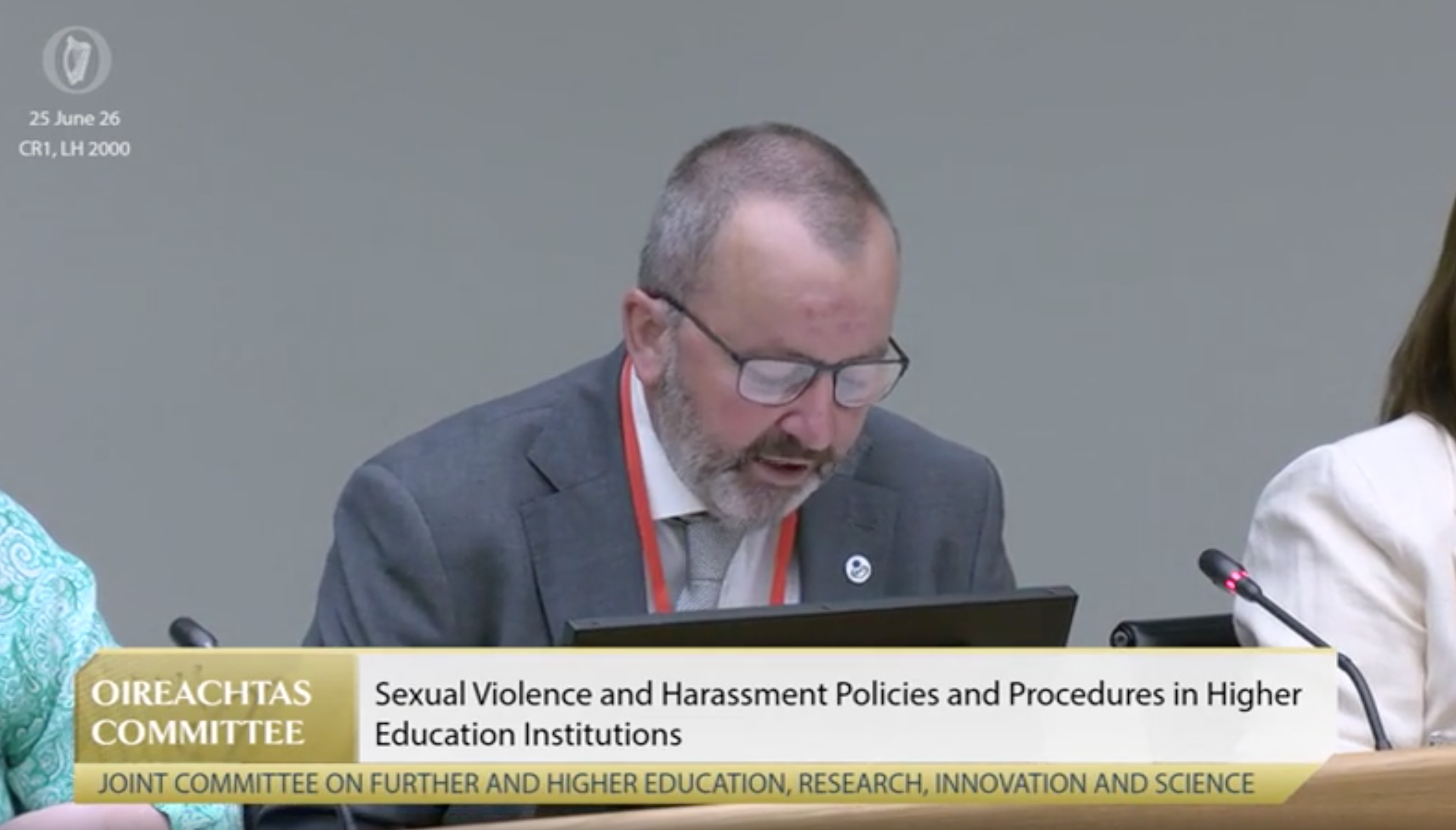
The Irish Federation of University Teachers (IFUT) today appeared before the Joint Committee on Further and Higher Education, Research, Innovation and Science to contribute to its examination of Sexual Violence and Harassment (SVH) policies and procedures across Ireland's higher education sector.
Presenting evidence on behalf of IFUT, General Secretary Frank Jones welcomed the Committee's decision to examine the effectiveness of current arrangements, stressing that every student and every member of staff has the right to study and work in an environment free from violence, harassment, intimidation and abuse.
During his opening statement, Mr Jones drew the Committee's attention to work previously undertaken by the Higher Education Authority (HEA), including IFUT's participation in the HEA Advisory Working Group on Ending Sexual Violence and Harassment in Higher Education. He noted that the Working Group had concluded that the current model—where institutions individually procure external investigators and legal services on a case-by-case basis—is unlikely to be sustainable over the longer term.
The Working Group recommended the establishment of a shared service investigations unit for the higher education sector, capable of providing trained investigators to institutions while promoting consistency, expertise and best practice.
Mr Jones also highlighted that the HEA's Ending Sexual Violence and Harassment in Higher Education Institutions Implementation Plan 2022–2024 identified the need for a feasibility study into establishing a national panel of trained investigators. While the HEA subsequently issued a Call for Collaboration to develop sectoral guidelines and standards for investigations, IFUT noted that it has yet to see the outcomes of that work.
Addressing the Committee, Mr Jones expressed concern at the increasing reliance by higher education institutions on external investigators, barristers, solicitors and consultants to investigate complaints.
"Our concern is not with the professionalism or integrity of external investigators," Mr Jones told the Committee. "Rather, we believe it is timely to ask whether the current fragmented model represents the most effective use of public resources and whether it delivers the consistency, expertise and institutional learning that the sector requires."
IFUT argued that the current approach fragments expertise across multiple providers, limiting opportunities to develop sector-wide learning, improve procedures and promote greater consistency in the handling of cases.
The submission also highlighted the increasingly legalistic nature of investigative processes, noting that complainants, respondents and witnesses frequently require representation to navigate lengthy and complex procedures. While Employee Assistance Programmes can provide valuable wellbeing supports, IFUT pointed out that they do not provide procedural advice, advocacy or representation, leaving trade unions to shoulder much of the responsibility for supporting members throughout investigations.
To address these concerns, IFUT called on the Committee to commission and oversee a comprehensive review of the current arrangements governing the investigation of sexual violence and harassment complaints across higher education institutions.
Among the issues IFUT believes should be examined are:
· Total annual expenditure by higher education institutions on external investigations and associated legal services.
· The number, nature and average cost of investigations conducted each year.
· The sector's reliance on external providers and whether this represents a sustainable long-term model.
· The adequacy of supports available to complainants, respondents, witnesses and trade unions.
· The mechanisms currently in place to capture institutional and sectoral learning arising from investigations.
· Whether existing arrangements provide sufficient transparency, accountability, consistency and value for public money.
· The feasibility of establishing a shared national investigative service or specialist unit to support institutions, develop expertise and promote consistent practice across the higher education sector.
Concluding his evidence, Mr Jones thanked the Committee for the opportunity to contribute to its important work and reaffirmed IFUT's willingness to engage further with any review aimed at strengthening policies and procedures across the sector.
"IFUT believes there is a compelling case to examine whether a shared national investigative resource could deliver better outcomes for all parties while ensuring the more effective use of public resources. We look forward to continuing to work constructively with the Committee as it considers these important issues."